


HASTA -50% + Regalo desde 200 €
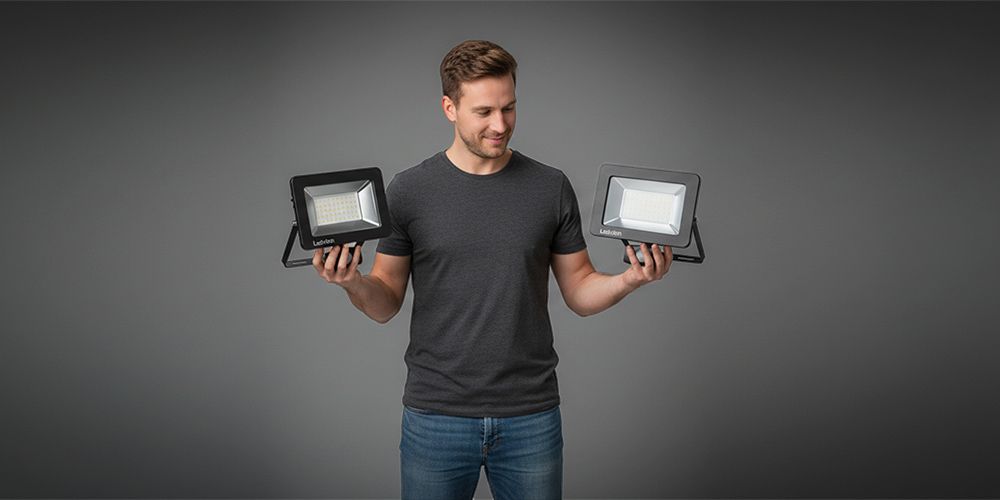
An LED floodlight is an efficient way to illuminate outdoor areas, loading docks, workspaces or façades safely and evenly. But which floodlight best suits your situation? Installers and facility managers typically focus on three technical factors: wattage, IP rating and beam angle. In this article, we explain how to make the right choice — and how to save additional energy with your existing installation.
Wattage indicates how much light a floodlight can produce and determines whether an area, façade or workspace is adequately illuminated. Modern LED floodlights come in a wide range of power levels, allowing you to choose precisely for each situation. It’s therefore important not to automatically select the highest wattage, but to consider the size of the area, mounting height and desired light distribution.
Mounting height | Recommended wattage | Application |
2–3 metres | 10–20W | Garden, small passages, façade lighting |
3–5 metres | 20–50W | Small parking areas, warehouse entrances |
5–8 metres | 50–100W | Large outdoor areas, loading zones |
8+ metres | 100–200W+ | Logistics zones, industrial sites with high lighting requirements |
An IP rating indicates how well a fixture is protected against dust and water. For LED floodlights, this is crucial because they are often installed outdoors and exposed to rain, dirt and temperature changes. With the correct IP rating, the lighting remains reliable and lasts significantly longer.
● IP65: Fully dustproof and resistant to splashing/spraying water. Suitable for almost all outdoor environments.
● IP66/IP67: Extra protection in heavy rain, high-pressure cleaning or dirt-prone environments.
A higher IP rating increases durability and reduces the risk of failures, lowering maintenance costs.
The beam angle determines how widely the light is distributed. Choosing the wrong one leads to dark spots or wasted light.
● 30–60°: Focused light for high mounting points or accent lighting.
● 90–120°: Wide light distribution for outdoor areas and façades.
For motion-controlled lighting, you can also opt for a floodlight with a sensor. It switches on automatically upon detection — ideal for energy savings in areas with varying activity.
Choosing the right LED floodlight means evaluating wattage, IP rating and beam angle. This ensures sufficient brightness, long lifespan and maximum efficiency. With sensors, smart controls and periodic checks, you can get even more from your installation. This reduces energy consumption and keeps your site or building reliably illuminated.


